
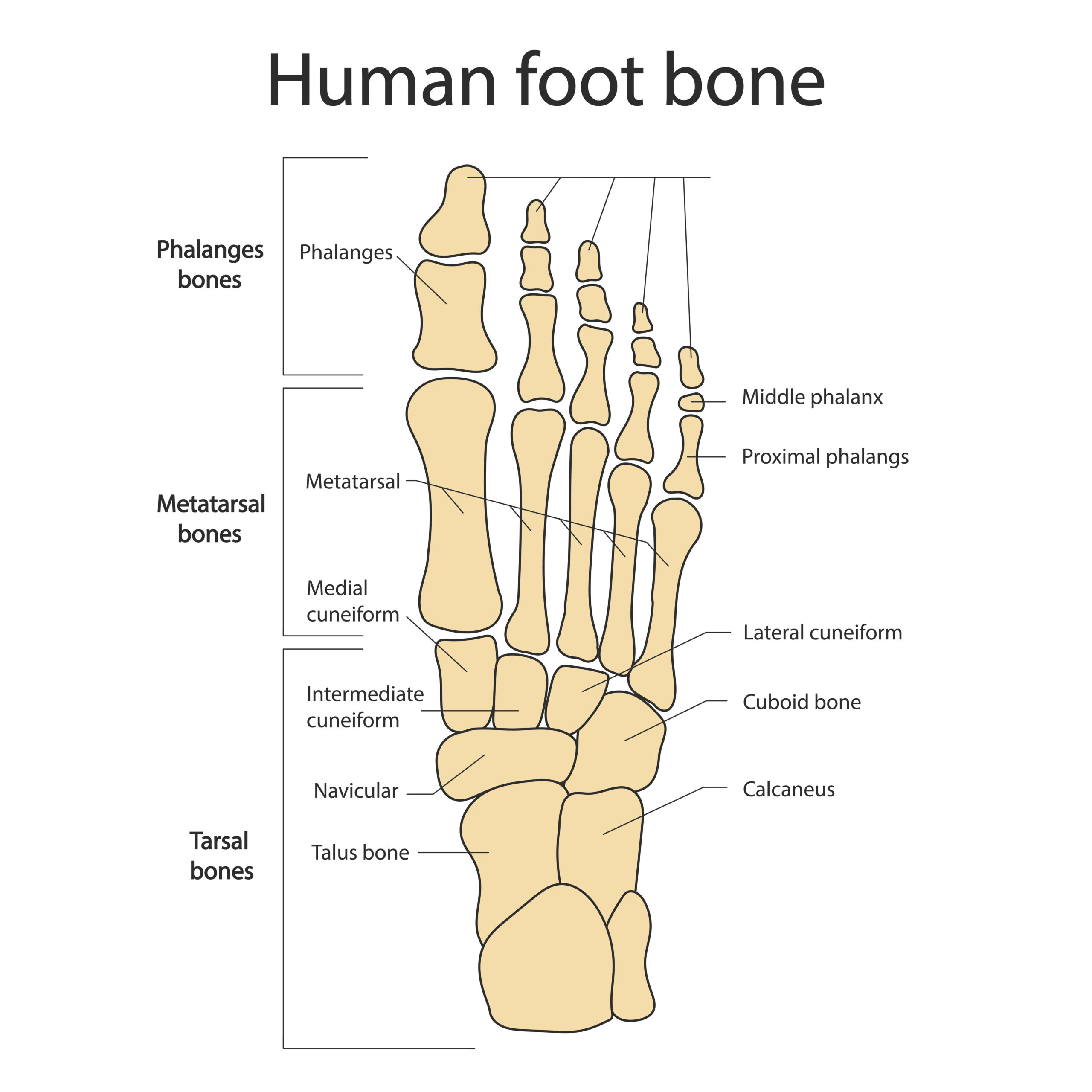
The human foot and ankle contain 26 bones that work together with 33 joints and various muscles to provide support, balance, and mobility. They are divided into three main sections: the ankle, midfoot, and forefoot
The Ankle & Rearfoot (Hindfoot)
The ankle joint (talocrural joint) connects the foot to the lower leg and allows for upward and downward movement.
Tibia: The shinbone; its lower end forms the inner bump of the ankle.
Fibula: The smaller calf bone; its lower end forms the outer bump of the ankle.
Talus: The main ankle bone that sits between the heel and the lower leg bones.
Calcaneus: The heel bone; it is the largest bone in the foot and absorbs the impact of walking.
The Midfoot
The midfoot creates the arch of the foot and acts as a shock absorber. It is made up of five irregularly shaped tarsal bones:
Navicular: A boat-shaped bone located just in front of the talus.
Cuboid: A cube-shaped bone located on the outer edge of the foot, in front of the heel bone.
Cuneiforms (3): The medial, intermediate, and lateral cuneiform bones sit in front of the navicular.
The Forefoot
The forefoot contains the long bones and the toes.
Metatarsals (5): These long bones connect the midfoot to the toes, labelled 1 through 5 (from the big toe to the pinky toe).
Phalanges (14): The toe bones. The big toe has two phalanges (proximal and distal), while the remaining toes each have three (proximal, middle, and distal).
Sesamoids (2): Two tiny, round bones embedded in the tendons beneath the big toe joint
Call us today to resolve all your foot pain
www.mypodiatrist.co.nz
#stepandstridepodiatry
(09) 212 9612